

Have you ever walked into a high-end property and felt like leaving almost immediately? Everything may be new and beautifully finished, yet the space feels uncomfortable. Then you visit another place—perhaps a restaurant, courtyard, or office property—and you find yourself slowing down. You would gladly wait a few minutes. You want to stay.
As a landscape designer, I’m interested in what creates that difference. How can commercial landscape design make people want to stay?
Many people encounter feng shui in conversations about their homes. Its ideas about balance, orientation, and the relationship between spaces can also offer a useful way to think about commercial landscapes. Feng shui uses concepts such as yin and yang and the five elements to consider how a place is arranged and experienced.
Designing the Journey to the Front Door
For a restaurant, I might begin by looking at the journey from the parking area to the front door. Is the entrance easy to find? Does the landscape welcome you, or do you have to navigate around an oversized planter, a wall, or dense shrubs? Is there a moment to take in the setting before you step inside?
Planting, stone, paving, and light can guide that journey without making it feel forced. A well-placed tree can offer shade and a sense of arrival. Layered planting can screen an unwanted view while leaving the entrance open. If a property has a beautiful outlook, the landscape can frame it instead of hiding it.
![Restaurant entry landscape concept plan with koi pond, floating deck, bamboo and granite boulders]() Balance Without Sameness
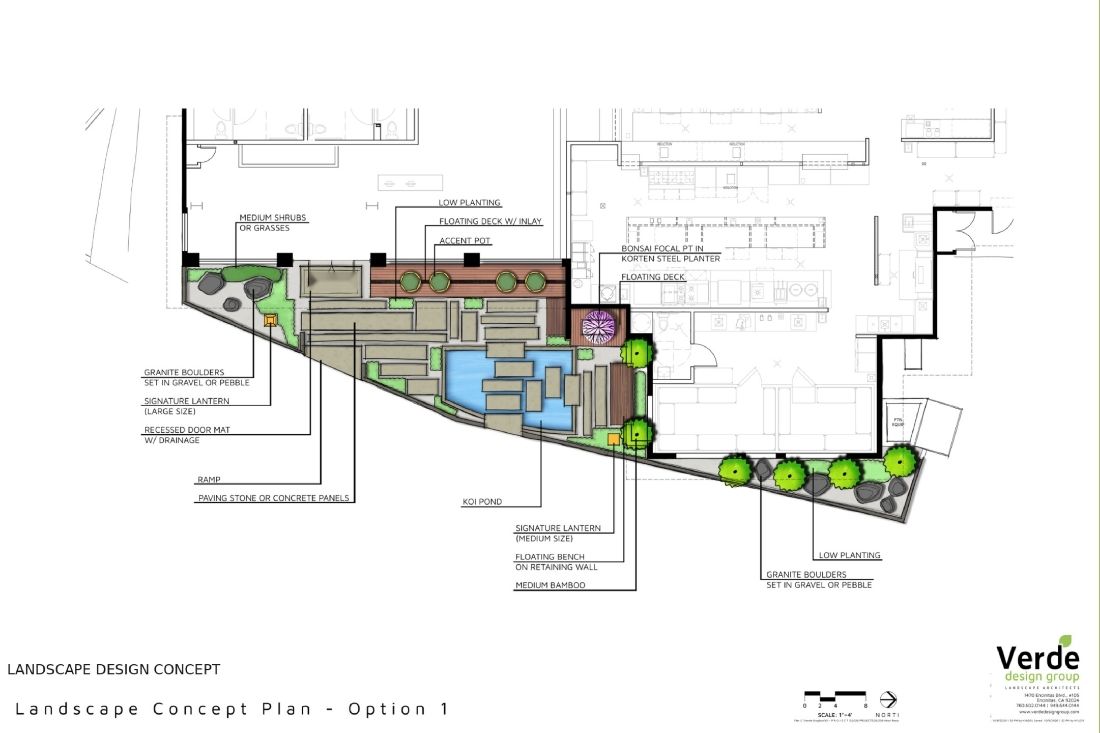
Balance does not mean making every part of a site look the same. A busy arrival area may call for stronger planting and clearer lighting. A place where people sit and linger may benefit from softer textures and a quieter composition. Sometimes the most valuable design decision is to leave space open and flexible.
![Restaurant entry landscape concept plan with waterfall, benches, signature lantern and low planting]() Commercial Landscape Design Beyond Restaurants
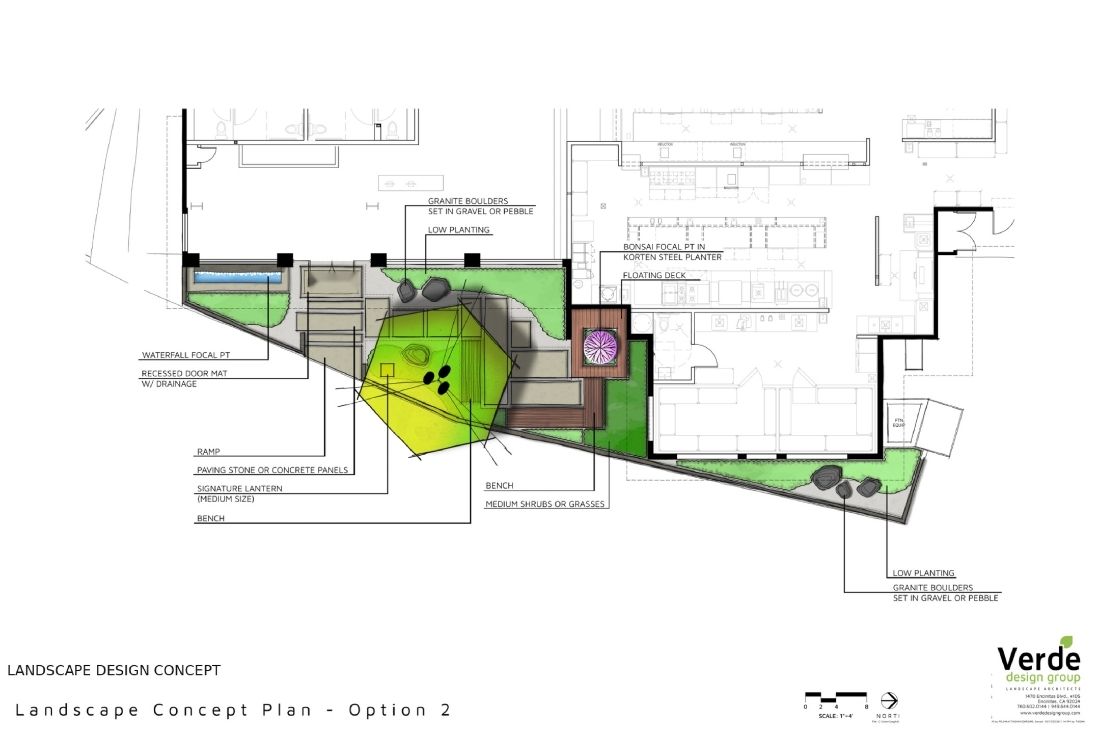
I think this matters beyond restaurants. An HOA entrance helps set the tone for a community. A civic landscape should help visitors feel welcome and find their way. At an industrial or commercial property, the approach can influence whether a prospective tenant sees a place that feels cared for and easy to use. Landscape design alone cannot make someone lease a building, but it is part of the experience they take away from a visit.
Designed to Last in Southern California
That experience also has to last. In Southern California, plants must suit the site’s sun, climate, water needs, and maintenance plan. California’s water-efficient landscape guidance calls for climate-adapted planting and irrigation matched to plant needs.
When I design, I want to understand both how a place works and how it feels. I want to create a soul for a place. The best landscapes make movement comfortable, give people room to pause, and bring the building and its surroundings into balance. You may not notice each individual design choice. You simply know you want to be there.
Planning a new landscape or refreshing a commercial, HOA, or hospitality property? Explore our work or contact our team to start the conversation.